Product Lead, Sole Developer & Chief Technology Officer
Platform
Web Application
Technologies
Django, Next.js, PostgreSQL, Stripe, AI Integration, REST APIs, Webhooks
Market
United Kingdom
Project Status
Live
01Overview
Doxtor is a white-label healthcare technology platform that enables clinics, pharmacies, and other licensed healthcare providers to offer blood testing services to their customers without the complexity and overhead of managing their own laboratory infrastructure.
The platform connects healthcare providers with laboratory services through an integrated digital workflow, handling everything from clinic onboarding and test ordering to sample tracking, laboratory results, patient notifications, and billing.
With Doxtor, healthcare providers can offer blood testing under their own brand, using their own domain, logo and brand colours, while Doxtor manages the technology and laboratory integration behind the scenes.
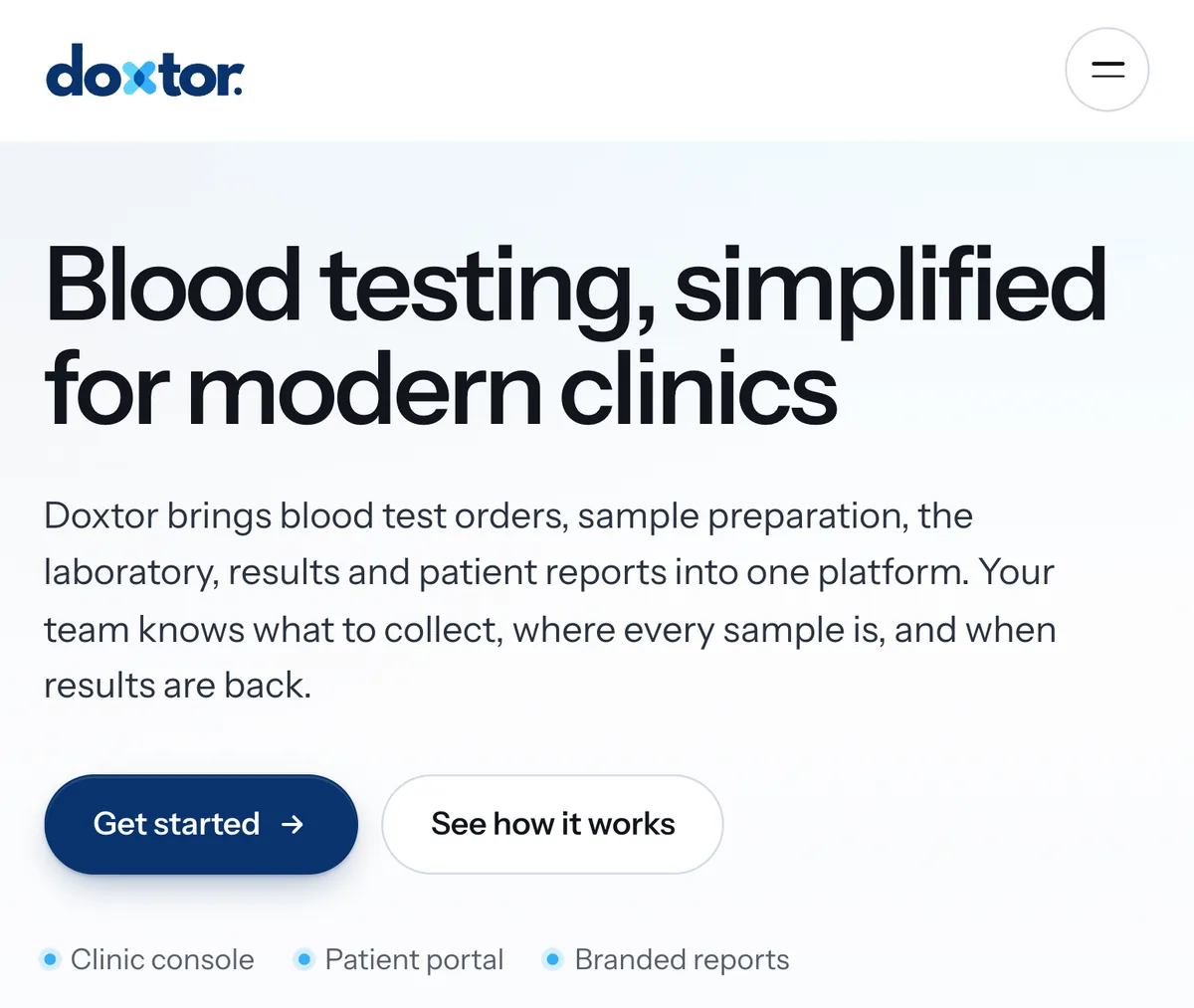
doxtor.health
Laptop Doxtor home page, doxtor.health.
My responsibility extended beyond software development. I conceived the current product direction, led the transition from a direct-to-consumer model to a B2B healthcare platform, selected the technology stack, architected and developed the application, and continue to oversee its technical direction as CTO.
02The Challenge
A business model that needed rethinking
Doxtor originally started as a direct-to-consumer blood testing business. Customers could purchase blood testing kits, collect their own samples, and send them to a laboratory for processing.
However, this model presented a significant challenge.
The direct-to-consumer blood testing market was already competitive, with established laboratories and healthcare providers offering similar services. We struggled to establish a sufficiently differentiated value proposition.
Rather than continuing to compete directly in an already crowded market, I proposed a different direction.
The opportunity
Instead of selling blood testing kits directly to consumers, why not empower existing healthcare providers to offer blood testing as an additional service?
Many clinics and pharmacies already had the necessary licensing and capabilities to collect blood samples, but lacked the infrastructure, technology, and resources to manage the complete testing process.
This presented an opportunity to build a platform that would:
Enable clinics to offer blood testing without operating their own laboratories.
Connect clinics directly with laboratory services.
Allow healthcare providers to operate under their own brands.
Automate order processing, sample tracking, and result delivery.
Create an additional revenue stream for participating clinics.
I proposed this strategic pivot to the founder, who agreed with the direction. This became the foundation of the Doxtor platform as it exists today.
03My Role & Responsibilities
I was responsible for the product's conception, technical architecture, and implementation.
As the sole developer who has worked on the application, I took ownership of the entire technical lifecycle.
My responsibilities included:
Defining product direction and feature priorities.
Identifying business opportunities and translating them into product functionality.
Selecting the technology stack and infrastructure.
Designing and developing the frontend and backend.
Building the clinic onboarding experience.
Implementing white-label functionality and custom domain support.
Developing laboratory API integrations and webhook workflows.
Implementing billing and payment infrastructure.
Integrating AI-powered biomarker interpretation.
Managing deployment, infrastructure, and application maintenance.
Overseeing the technical direction of the platform as CTO.
This meant I wasn't simply working from a predefined specification. I was involved in determining what the product should become, why particular features mattered, and how they should be implemented.
04The Product Evolution: From Bubble to a Custom-Built Platform
The initial version of Doxtor was built using Bubble.io.
Two major challenges emerged.
Before
Bubble.io
Bubble allowed us to validate the initial business model and launch relatively quickly. However, as the product evolved, its limitations became increasingly apparent.
1. White-label limitations
The new B2B model required clinics to operate the platform under their own identity. We needed proper branding controls and custom domain support, which our original implementation could not adequately deliver.
2. Operating costs and infrastructure control
As the application grew, running the platform on Bubble became increasingly expensive. We also needed greater control over the underlying infrastructure and technical implementation.
After
A custom technology stack
I therefore decided to move away from Bubble and rebuild the platform using a custom technology stack. The new architecture uses:
Django
Backend application and business logic.
Next.js
Frontend application.
PostgreSQL
Relational data storage.
Stripe
Payment processing and recurring billing workflows.
REST APIs and webhooks
Communication between Doxtor and laboratory services.
AI integration
Biomarker interpretation and result explanations.
This migration gave us the flexibility to implement the white-label architecture, control infrastructure costs more effectively, and build features around the actual needs of the business.
05Key Product Features
White-label infrastructure
One of the most important additions was the ability for clinics to operate Doxtor under their own brand.
Each clinic can:
Upload its own logo.
Configure its primary brand colour.
Connect a custom domain.
Present the platform as its own service.
The objective was to give clinics ownership of their customer-facing experience without introducing the complexity of a website builder or requiring technical knowledge.
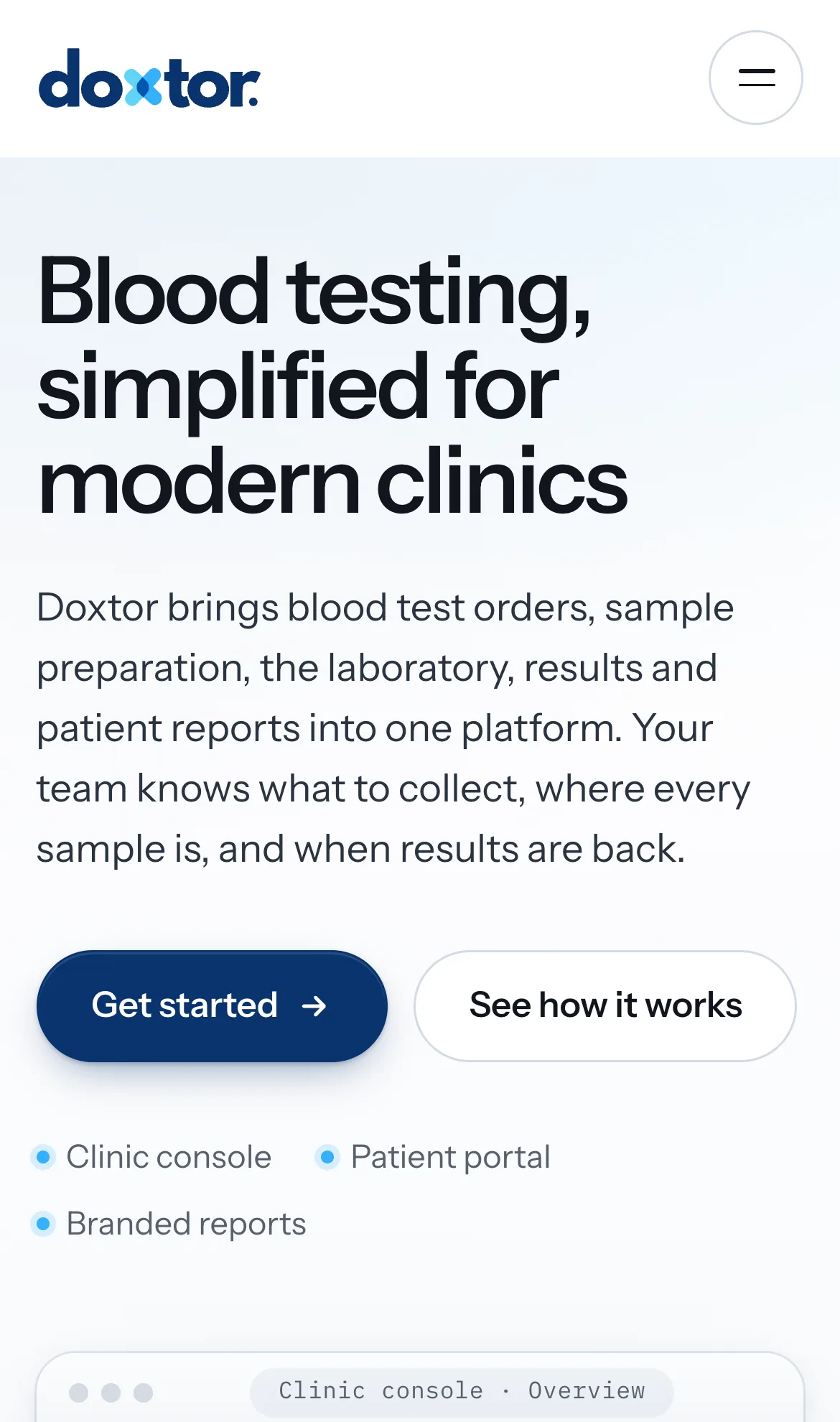
Phone, 390px Doxtor home page on a phone.
Simplified clinic onboarding
One of the problems with the original platform was that clinics frequently needed assistance understanding how to use it.
I prioritised rebuilding the onboarding experience to make clinics more independent.
The onboarding process allows clinics to:
Enter their business information.
Upload their branding assets.
Configure their testing panels based on available biomarkers.
Add a payment card through Stripe.
Complete the essential setup before placing orders.
I also introduced guided instructions to explain how the platform works and what clinics need to do when processing an order.
The goal was to reduce unnecessary support interactions and make clinics productive as quickly as possible.
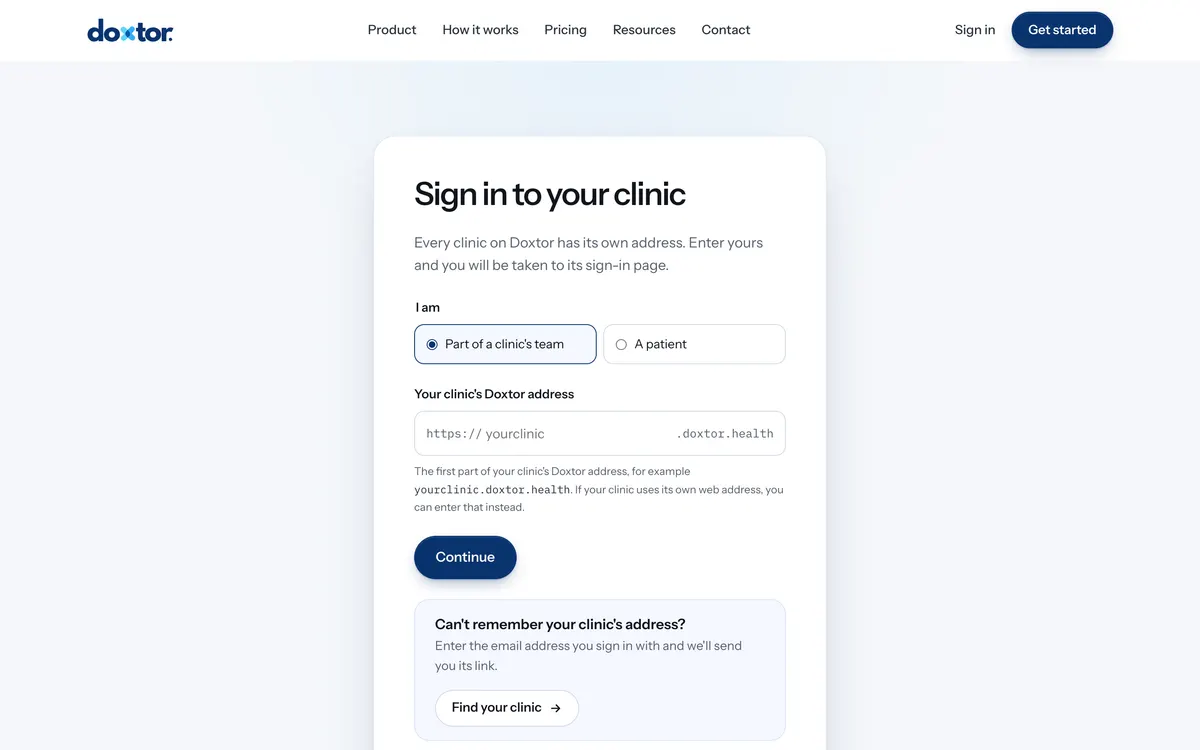
doxtor.health
Desktop Doxtor sign-in, doxtor.health.
Laboratory integration and automated order processing
I developed a direct integration between Doxtor and its laboratory partner.
When a clinic creates an order, Doxtor sends the relevant patient and testing information to the laboratory through an API integration.
The laboratory receives the order before the physical sample arrives, allowing it to identify and process the sample using its unique barcode.
The integration supports a workflow that includes:
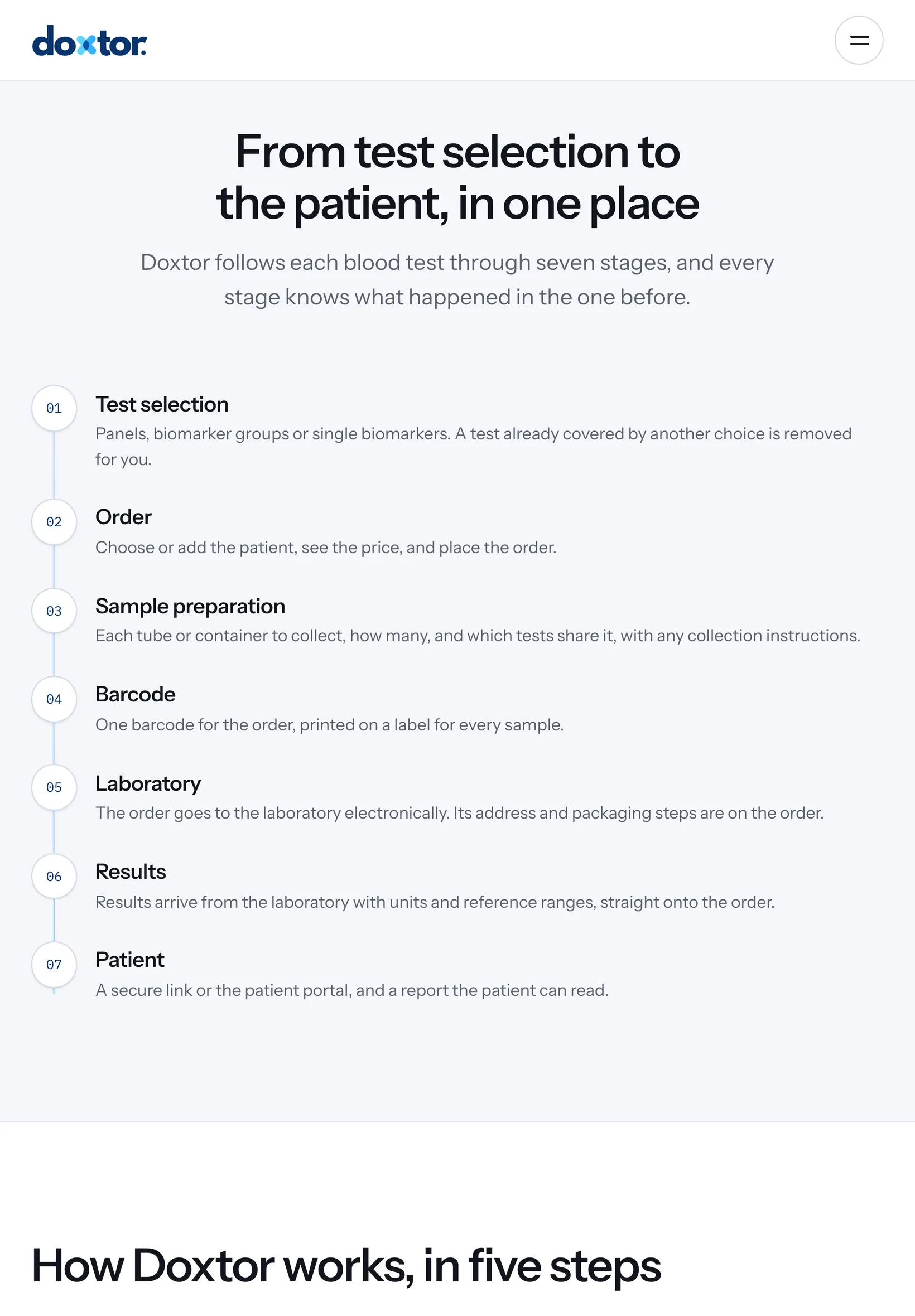
01Order submission to the laboratory.
02Barcode-based sample identification.
03Sample dispatch updates from the clinic.
04Laboratory sample-received notifications through webhooks.
05Automated email notifications to clinics.
06Laboratory result delivery through webhooks.
07Result processing and presentation within Doxtor.
Once the laboratory receives a sample, processing typically takes 24-48 hours.
This removes much of the manual communication that would otherwise be required between clinics and laboratories.
Tablet, 820px Doxtor seven stages section on a tablet.
Patient portal and historical biomarker tracking
I introduced a patient-facing portal that allows patients to access their testing information.
Rather than receiving a single test report and losing access to their previous results, patients can view historical biomarker data and monitor changes over time.
The portal also supports appointment booking, allowing patients to request appointments directly with participating clinics.
This creates additional opportunities for patient engagement and repeat business while giving patients better access to their health information.
AI-powered biomarker interpretation
I integrated AI capabilities to help clinics understand laboratory results more easily.
The system can generate explanations and interpretations based on biomarker results, helping clinics understand what particular results may indicate.
An important consideration was patient data privacy.
The AI integration was designed to avoid sending personally identifiable patient information to the AI service.
Sent to the AI service
Relevant testing data only
Biomarker names.
Biomarker results.
Units of measurement.
Patient age.
Patient sex.
Excluded
Direct patient identifiers
Names.
Email addresses.
Dates of birth.
Other direct patient identifiers.
The resulting interpretations are presented as informational support, with clear disclaimers that they do not constitute medical advice or replace professional clinical judgement.
Automated billing and payment management
I also developed the platform's billing infrastructure using Stripe.
Initially, clinics were charged immediately when individual orders were completed. However, this introduced an unnecessary payment processing cost because Stripe charged fees for each invoice.
Given the relatively tight margins in the blood testing business, this was not commercially sustainable.
I redesigned the billing workflow around weekly consolidated billing.
Instead of invoicing every order individually, the system aggregates a clinic's orders over a seven-day period and charges the clinic for the accumulated balance.
Clinics must maintain a valid payment method before placing orders. If a weekly payment fails, further ordering is restricted until the outstanding payment is resolved.
This helped reduce unnecessary transaction costs while providing a more manageable billing experience for clinics.
06Engineering Challenges & Solutions
Challenge 1
Implementing practical white-label functionality
The problem
Building a white-label platform involved more than allowing clinics to upload logos.
The challenge was creating an experience where each clinic could present the application under its own identity, including custom domain support, without making the setup process complicated.
Solution
I designed a simplified branding configuration that gives clinics control over their logo, primary colour and custom domain while keeping the underlying application consistent and manageable.
Challenge 2
Making the platform easy for non-technical clinic operators
The problem
Clinics needed to understand how to configure their accounts, select testing panels, place orders, and prepare samples correctly.
The original experience resulted in unnecessary support requests.
Solution
I prioritised clinic onboarding, guided instructions, and contextual explanations throughout the ordering process.
Challenge 3
Optimising billing economics
The problem
Individual order invoicing introduced additional transaction costs that affected the business's margins.
Solution
I redesigned the billing process around weekly consolidated payments, reducing the need to generate and process individual invoices for every order.
Challenge 4
Automating laboratory communication
The problem
Coordinating orders, physical samples, laboratory receipt, and results manually would introduce delays and unnecessary administrative work.
Solution
I implemented direct API communication and webhook-based updates, enabling the platform and laboratory to exchange information throughout the order lifecycle.
Challenge 5
Introducing AI without unnecessarily exposing patient information
The problem
AI-powered interpretation needed relevant patient context to provide useful explanations, but sending personally identifiable information to an AI service was unnecessary.
Solution
I designed the integration around data minimisation, sending only relevant biomarker information and limited demographic context while excluding direct patient identifiers.
07Business Impact & Results
Doxtor has evolved from an initial direct-to-consumer testing business into a B2B healthcare technology platform serving clinics across the United Kingdom.
Current platform performance includes:
75+
clinics
Healthcare providers using the platform across the UK.
400-500
orders per week
Blood testing orders currently processed through the platform.
Thousands of pounds
in additional weekly revenue
The platform enables participating clinics to generate additional revenue by introducing blood testing as an additional service without having to operate their own laboratories.
Beyond these figures, the platform has established a scalable operating model that connects healthcare providers, patients, and laboratory services through a unified digital workflow.
08What I Learned
Doxtor reinforced an important product development principle: sometimes the biggest opportunity isn't building a better version of an existing product, but identifying a different problem worth solving.
The initial direct-to-consumer model placed us in a competitive market where differentiation was difficult.
By shifting our focus to enabling existing healthcare providers, we created a more compelling value proposition and a product with a clearer business model.
It also reinforced the importance of building around real operational constraints. Decisions such as weekly consolidated billing, guided clinic onboarding, and practical white-label functionality weren't just technical improvements. They directly addressed the economics and usability of the business.
09The Outcome
Today, Doxtor is a live healthcare technology platform supporting more than 75 clinics and processing approximately 400-500 orders every week.
What started as a direct-to-consumer blood testing concept has become a white-label infrastructure platform that helps healthcare providers expand their services, generate additional revenue, and deliver a more connected patient experience.
I led that transformation from product strategy and architecture through to implementation and ongoing technical leadership.
Project takeaway
I didn't just build a healthcare application. I helped identify a new business model, transformed it into a working product, and built the technology infrastructure that enables healthcare providers to offer blood testing at scale.